Research Library

Tourism in Central Florida: Why Tourist Development Tax Revenue Should Not Be Diverted

Energy & Environment, Research, Taxes, Tourism

Each year, more than one hundred million visitors come to Florida to enjoy its beaches, warm temperatures, and its numerous parks, thrills, and attractions. Latest FloridaCommerce data confirm that Florida set a new all-time annual record in calendar year 2024 with 143 million visitors an increase of 1.7 percent over the previous record set in 2023. Out-of-state visitors to Florida spent $134.9 billion in calendar year 2024. For every $1 spent by a visitor, 99 cents stayed in Florida’s economy, with 59 cents supporting worker salaries. Tourism supported 1.8 million jobs in 2024 and generated $79.9 billion in wages, including $44 billion in direct wages. Tourism-related activity produced $33.6 billion in federal, state, and local taxes. Tourism accounted for 7.8 percent of Florida’s Nominal Gross State Product (GSP), contributing $133.6 billion to the state’s economy in 2024. Without tourism, Florida households would pay $1,730 more annually in state and local taxes alone to sustain current levels of revenue.


Save Our Taxpayers – Property Tax Relief Must be Accomplished Equitably

Housing Affordability, Insurance, Local Government, Research, Taxes

Florida property tax levies have been rising rapidly—increasing by nearly 40 percent in just the last three years and more than doubling in the last ten years—with property taxes now totaling $59.2 billion (FY2025–26). With the Legislature’s increased focus on affordability, especially housing affordability, property taxes are expected to be a top issue during the 2026 legislative session.

Transferring Utility Profits to a Municipality’s General Fund Increases the Risk of Undercapitalization of Water Assets and Violate Taxpayer Accountability

Local Government, Research, Taxes

Setting water utility rates that incorporate the recovery of the costs associated with standard operating expenses and debt obligations is essential to ensuring the short-term and longer-term financial stability of the utility. Once these costs are covered, many publicly owned utilities make transfers to the General Fund (a practice known as “sweeping”) ostensibly to help pay for governmental services that do not generate revenue (e.g., roadway maintenance, public safety, etc.) and to help keep property taxes lower. Keeping property taxes low often means higher municipal utility rates to balance the general budget, a habitual practice that burdens utility customers with cross-subsidies and normalizes underinvestment in infrastructure.

The Fiscal and Economic Impacts of Nova Southeastern University on Florida’s Economy

Economic Development, Education, Health Care, Research, ROI Study, Taxes, Workforce Development

NSU generated an estimated $293.1 million in state and local taxes within the Tri-County region in FY 2024-25 and an estimated $305.1 million in state and local taxes in FY 2024-25.

Options to Eliminate or Reduce the Property Tax Burden on Florida Homeowners

Education, Housing Affordability, Local Government, Research, Taxes

Florida’s property tax system is at a critical juncture, with total levies surging by 108% over the last decade, far exceeding the combined rate of population growth and inflation. This rapid increase, generating $55 billion in 2024 for local governments, has intensified the financial strain on homeowners and raised fundamental questions about the nature of property ownership, which currently resembles a form of “perpetual rent” to the government. This report from Florida TaxWatch analyzes the current landscape and explores five distinct options for reform, ranging from the complete elimination of property taxes for homeowners to more immediate statutory changes aimed at increasing transparency and accountability.

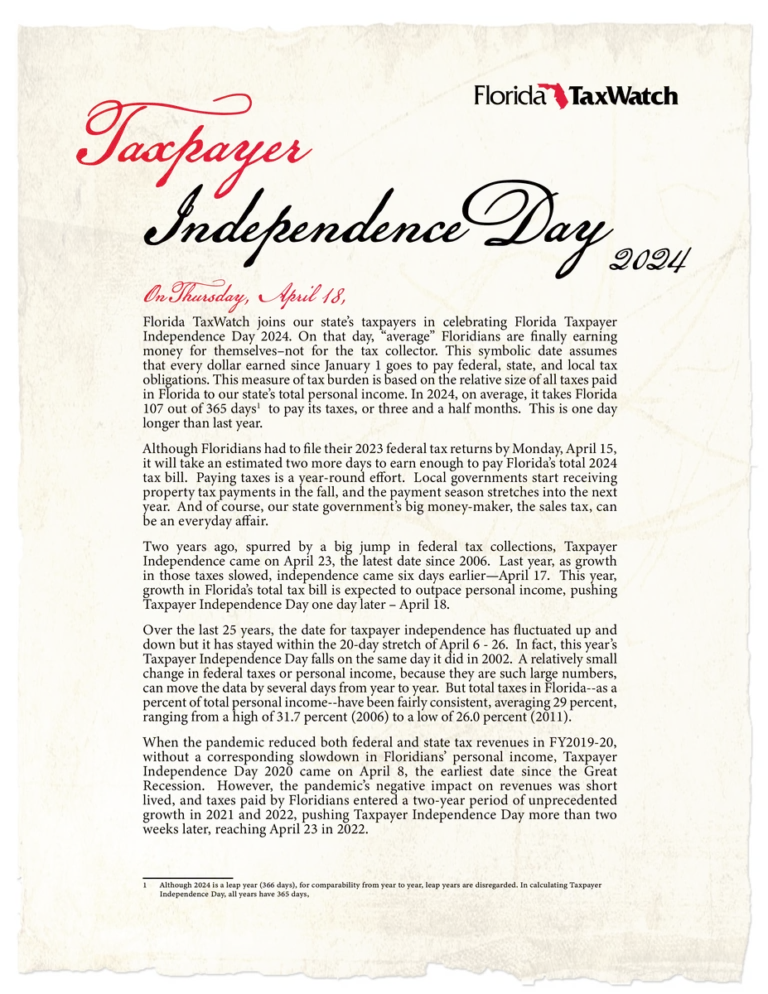
Florida Taxpayer Independence Day 2024

Research, Taxes, Taxpayer Guide

In 2024, Floridians will spend an average of 107 days working to pay off their tax obligations. The state’s total tax burden is estimated at $455 billion, with federal, state, and local taxes accounting for 71%, 15%, and 14%, respectively. Over the past decade, total taxes paid by Floridians have increased by 90%. Despite the challenges, Florida’s state tax burden remains one of the lowest in the nation. Download the full report to learn more about the tax landscape in Florida.

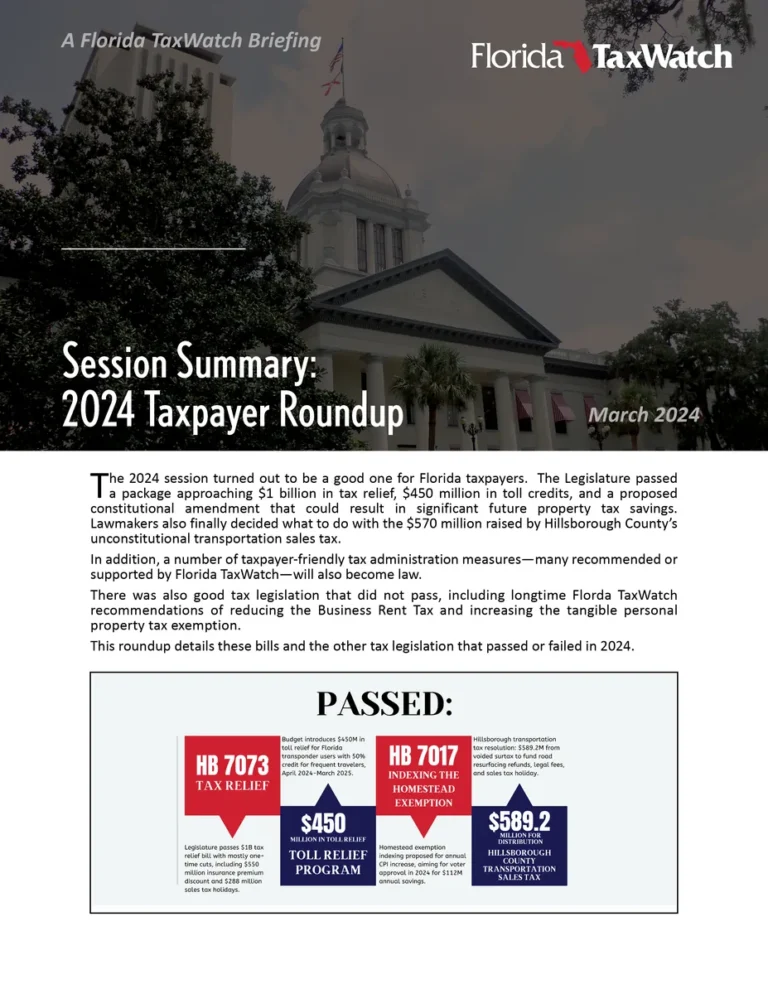
Session Summary: 2024 Taxpayer Roundup

Budget/Approps, Research, Taxes, Taxpayer Guide

The Florida TaxWatch’s 2024 Legislative Session Taxpayer Roundup report provides a comprehensive overview of significant tax legislation in Florida, highlighting nearly $1 billion in tax relief measures, including toll credits and potential property tax savings through a proposed constitutional amendment. Key successes include substantial tax cuts, sales tax holidays, and new tax credits aimed at supporting employment and child care.

An Analysis of the Tax Treatment of Credit Unions: Value of Florida Credit Unions’ Exemption Is Now $259 Million

Budget/Approps, Cost Savings, Economic Development, Local Government, Research, Taxes

Originally designed to serve specific community segments, credit unions have since expanded their reach and service offerings, making their tax exemptions increasingly valuable. From 1997’s exemption value of $89.1 million, the exemption’s worth has risen to $259 million in 2023. This report sheds light on the industry’s transformations, recent trends like mergers and acquisitions, and reevaluates the rationale behind the tax exemptions. It aims to fuel informed discussions on credit union taxation and their exemption status.

Statement by Florida TaxWatch President and CEO Dominic M. Calabro on Gov. DeSantis Signing Tax Relief Package, Upcoming Sales Tax Holidays

Cost Savings, Releases, Taxes

Tallahassee, Fla. – The statement below, to be attributed to Florida TaxWatch President and CEO Dominic M. Calabro, pertains to Gov. Ron DeSantis’ signage of HB 7063: Taxation, the state’s tax relief package, and the two upcoming sales tax holidays that will now be implemented on Sat., May 27 (Disaster Preparedness) and Mon., May 29 (Freedom Summer). To learn more and/or schedule an interview with President and CEO Calabro, please contact Aly Coleman Raschid at aly@on3pr.com or 850.391.5040.

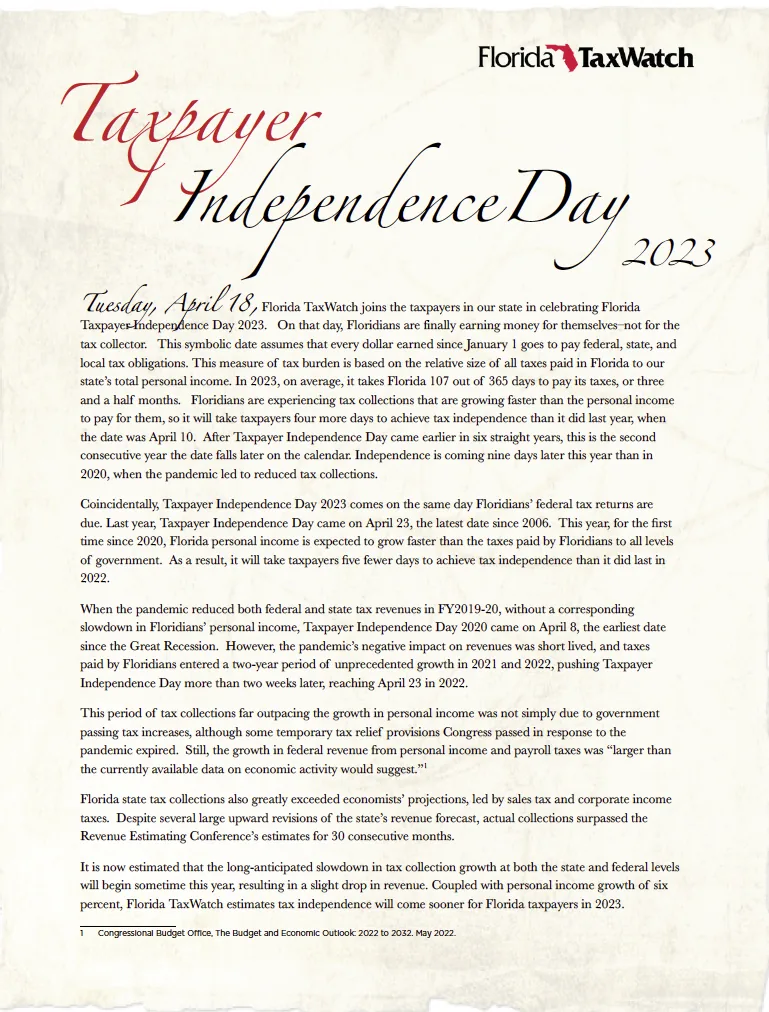
Taxpayer Independence Day 2023

Research, Taxes

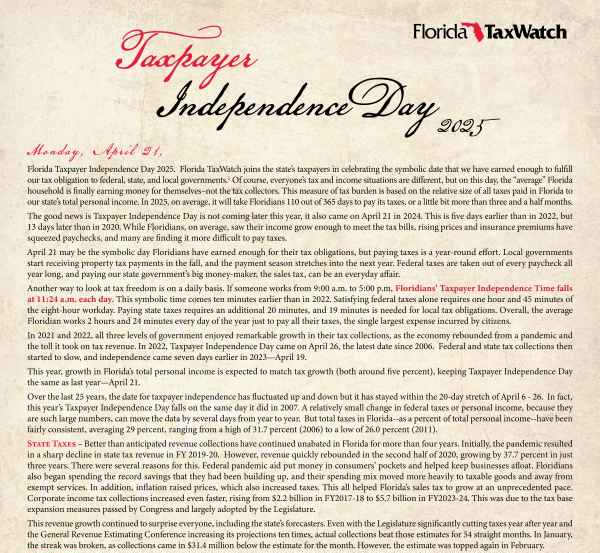
Tuesday, April 18, Florida TaxWatch joins the taxpayers in our state in celebrating Florida Taxpayer Independence Day 2023. On that day, Floridians are finally earning money for themselves–not for the tax collector. This symbolic date assumes that every dollar earned since January 1 goes to pay federal, state, and local tax obligations. This measure of tax burden is based on the relative size of all taxes paid in Florida to our state’s total personal income. In 2023, on average, it takes Florida 107 out of 365 days to pay its taxes, or three and a half months. Floridians are experiencing tax collections that are growing faster than the personal income to pay for them, so it will take taxpayers four more days to achieve tax independence than it did last year, when the date was April 10. After Taxpayer Independence Day came earlier in six straight years, this is the second consecutive year the date falls later on the calendar. Independence is coming nine days later this year than in 2020, when the pandemic led to reduced tax collections.

A Closer Look at Florida’s Sales Tax Exemptions

Budget/Approps, Cost Savings, Research, Taxes

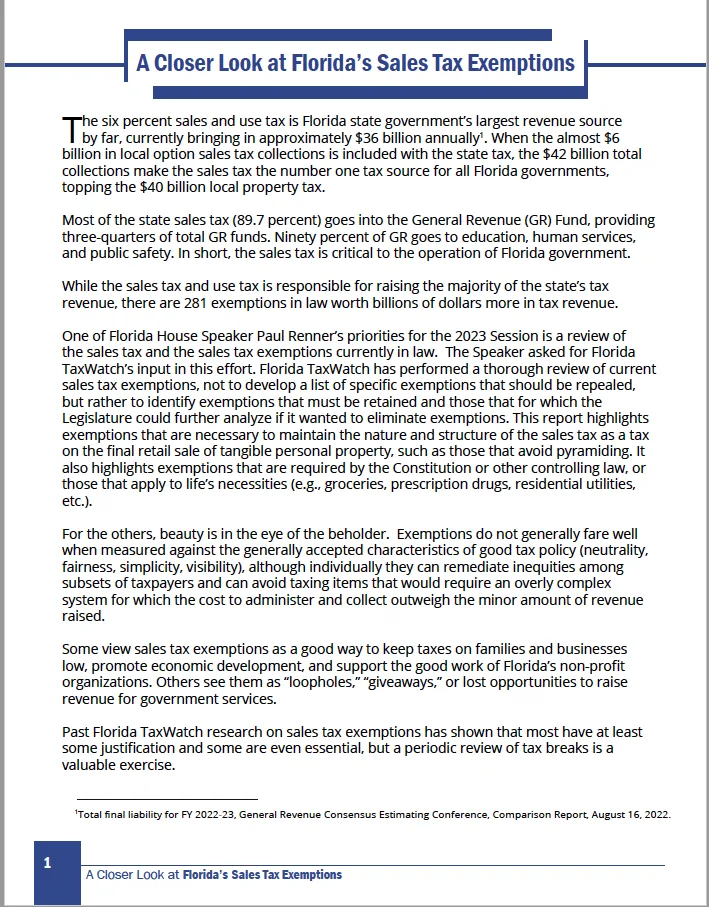
The six percent sales and use tax is Florida state government’s largest revenue sourceby far, currently bringing in approximately $36 billion annually. When the almost $6 billion in local option sales tax collections is included with the state tax, the $42 billion total collections make the sales tax the number one tax source for all Florida governments, topping the $40 billion local property tax.

Florida TaxWatch Briefing: Extending State Group Insurance to the Florida College System

Health Care, Insurance, Research, Taxes

Florida’s economy is strong. If Florida were a country, its gross domestic product (GDP) would rank 14th among economies worldwide, and its ambitions do not stop there. Florida aims to be within the top ten economies by 2030. By this time, two in three jobs are expected to require specialized training, a credential, or a degree. To achieve its economic goal, Florida will need to continue developing its specialized workforce. With 120,000 students completing Florida College System (FCS) programs each year, the FCS plays a critical role in providing the talent pipeline necessary to reach Florida’s economic goal and does so at a very affordable cost to students and Florida taxpayers alike.

How Florida Compares: Taxes 2022

Research, Taxes, Taxpayer Guide

The annual Florida TaxWatch How Florida Compares: Taxes report ranks Florida’s state and local taxes against those levied around the nation. The nearly 40 tables, charts, and graphs in this report provide comprehensive information on state and local tax rates, tax collections, and other government revenues for all 50 states, and historical information for Florida.

Florida Voters Continue to Say Yes to Proposed Tax Increases

Research, Taxes

At the state level, taxpayers in Florida have enjoyed tax cuts passed by the Legislature every year since 2009.  However, at the local level, Florida voters continue to vote to significantly increase the taxes they pay.  A 2021 Florida TaxWatch report discovered that since 2010, Floridians voted to increase their own taxes 142 times. This includes voting to extend existing expiring tax levies.  

ARE BIG PROPERTY VALUE INCREASES GOING TO MEAN BIG TAX INCREASES?

Budget/Approps, Research, Taxes

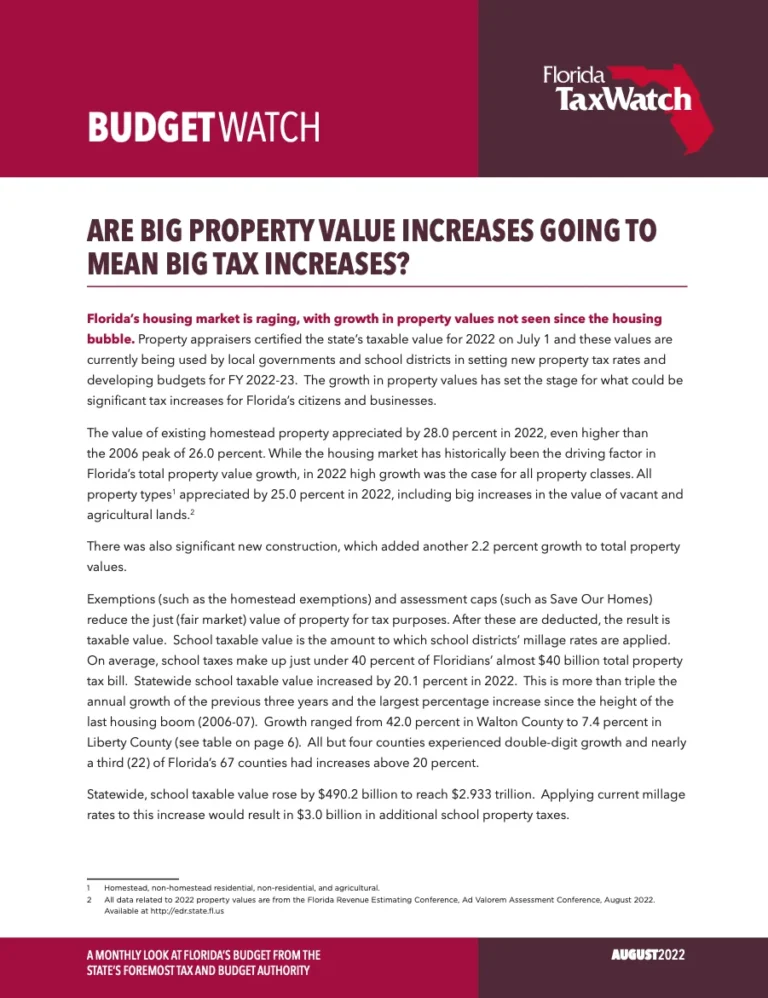
Florida’s housing market is raging, with growth in property values not seen since the housing bubble. Property appraisers certified the state’s taxable value for 2022 on July 1 and these values are currently being used by local governments and school districts in setting new property tax rates and developing budgets for FY 2022-23. The growth in property values has set the stage for what could be significant tax increases for Florida’s citizens and businesses.

Looking Back at Census 2020: What Florida’s Business and Community Leaders Need to Know

Census, Economic Development, Research, Taxes

An undercount is nothing new to Florida, but its current persistence inflicts costs more formidable than in previous years.  Throughout the decade, Floridians can expect to lose between $11 billion and $21 billion. The decennial Census count and American Community Survey (ACS) help communities understand local patterns of population growth, specialized workers, income, employment statuses, and transportation needs.

Become a Member

Support Responsible
Taxation & Government Spending

For over 45 years, donor support has made Florida TaxWatch the state’s leading independent voice for taxpayer accountability. There are many ways to support our mission.

Scroll to Top