Dear Fellow Taxpayer,
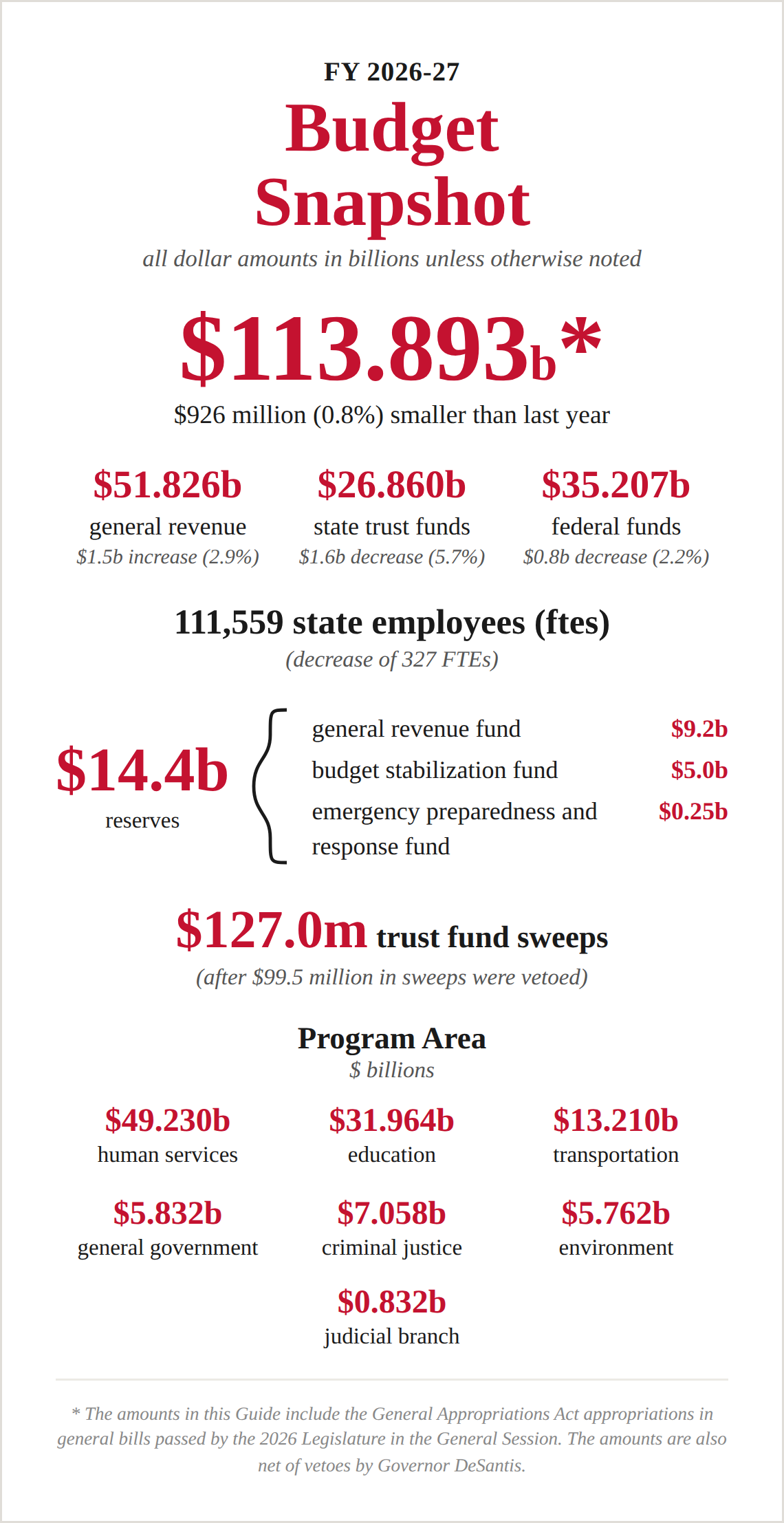
Florida TaxWatch is pleased to present taxpayers with a guide to the FY2026-27 state budget, which went into effect July 1, 2026. The 2026 Legislature appropriated a total of $113.9 billion for the new fiscal year, a reduction of $926 million (0.8 percent) from FY2025-26 spending. This is the second year in a row that the bottom line of the budget has decreased. The budget funds 111,559 state employee positions, a reduction of 327 (mostly vacant) positions. This marks the third year in a row that the total number of positions has decreased.
This Budget Guide includes all appropriations for FY2026-27— those in the 2026 General Appropriations Act (GAA) and those made in general bills. Appropriations are net of the line-item vetoes by Governor DeSantis.
For the second year in row, the Legislature could not produce a new state budget on time, the only thing they are constitutionally required to do, so they had to return for a special session.
Familiar tensions arose during the session, and it became obvious early on that the budget was going to take extra time. House Speaker Daniel Perez said there was a “fundamental disagreement on what the state budget should look like.” He said the House wanted to spend less, and the Senate wanted to spend more, and he was not going to be very flexible on that. This proved true, as the original plan was to return to Tallahassee in mid-April to finish the budget, but the conference committee process did not start until a month later. The budget was signed by the Governor on June 29, two days before the new fiscal year began.
The House and Senate budget proposals totaled $113.6 billion and $115.0 billion, respectively. After a prolonged budget conference, the two chambers compromised on a $114.5 billion spending plan. Although the new budget has a smaller published bottom line, it spends $1.5 billion more in General Revenue (GR) than in the current year. This is despite warnings that the Legislature is facing potential GR budget shortfalls beginning next year. Much of the new spending is non-recurring appropriations, and there was more non-recurring revenue available than previously thought. In addition, the 2026 Legislature only provided recurring tax relief of $16.0 million in GR annually, much less than the $593.8 million assumed in the shortfall forecast (based on the average of the last three years). At a minimum, it is likely that the Legislature postponed any budget shortfall.
The Governor’s vetoes lowered the budget total by $660.0 million. He also vetoed some budget transfers and trust fund sweeps which are not appropriations and do not reduce spending. Adding $91.4 million in FY2026-27 appropriations made in general bills and the back of the bill (see pages 26-28) brings the net total of the new budget is $113.9 billion.
It should be noted that this does not include all appropriations made by the 2026 Legislature. Using a common practice that is becoming more prevalent, the GAA also appropriates $4.5 billion for FY2025-26, not the new budget year (see page 29). Since this is technically appropriated for last year, even though most of it will be spent this year, it is not included in the budget total. This understates the total appropriations made by the Legislature.
Despite the call for a leaner budget, legislators requested more hometown projects than ever before. The budget includes nearly 2,000 of those local member projects. The Florida TaxWatch annual Budget Turkey Watch report identified 631 appropriations totaling $829.7 million that qualify as “Budget Turkeys.” These are appropriations that bypass or violate established budget procedures or legislative and public scrutiny. In addition, the report highlighted $441.1 million in projects that, while not meeting the strict Budget Turkey criteria, certainly merited extra scrutiny and close gubernatorial review. These two groups of appropriations are almost entirely member projects. The Governor vetoed 342 projects that were identified in the Budget Turkey Watch report, worth $229.7 million.
In addition to explaining this year’s budget and detailing the highlights, this guide also provides past data to put it in historical context. We hope this annual Budget Guide gives you the information you need to better understand where and how your hard-earned tax dollars are being spent.
Sincerely,
David Casey
Chairman of the Board of Trustees

Lt. Gov. Jeff Kottkamp
President & Chief Executive Officer
Education Budget Highlights
The Florida Education Finance Program (FEFP) will provide $30.0 billion to school districts, an increase of $735.9 million (2.5 percent). In four of the last five years, local property taxpayers paid for more of the added funding. This year, the state is paying a larger share. The Legislature is commended for rolling back the Required Local Effort (RLE) millage rate from 3.092 to 3.057. Still, the RLE and the discretionary millage will bring in $322.0 million. The state increased its contribution by $413.9 million.
Per-Student FEFP Funding of $9,130 is an increase of $143 per student (1.6 percent), the smallest increase since FY2021-22. There will be an estimated 53,784 additional students in public schools this year. The base student allocation (mostly flexible funding) will increase by $42 per student (0.8 percent).
Teacher Compensation – The Legislature provided $1.56 billion for teacher salary increases, which includes $200 million for teachers with at least 10 years of teaching experience.
Workforce Education – The budget provides an additional $49.7 million, including a $9.7 million increase for school district career and technical center operations and a $40.0 million GR restoration for the Workforce Development Capitalization Grant Program.
Early Learning – An overall increase of 4.0 percent, including $2.8 million to continue supporting the Summer Bridge Program for Voluntary Pre-K Program (VPK) students who score below the 10th percentile on the Coordinated Screening and Progress Monitoring (CSPM) System. An estimated 221 fewer students resulted in a $436,000 decrease in VPK funding.
Higher Education – The $40.0 million in funding for Florida’s five Preeminent State Research Universities was eliminated. The state maintained the $350 million state investment in performance funding. Nursing education received $100 million for the PIPELINE incentive fund to award and incentivize continuous improvement of nursing program completion and licensure rates. Funding for the Linking Industry to Nursing Education (LINE) Fund was maintained at $30 million to incentivize collaboration between nursing education programs and healthcare partners to expand nursing education and faculty recruitment. State colleges received a $30 million workload increase.
Public Education Capital Outlay
Maintenance – All state funds for maintenance went to charter schools ($260.2 million). Once again, traditional public schools, colleges, and universities receive no maintenance funding.
Higher Ed Construction Projects – It was a good year for new education facilities. The Legislature funded 30 projects at state colleges ($209.1 million) and 31 projects at universities ($465.5 million). The Legislature again deviated considerably from the state’s approved projects lists, as pointed out in the Florida TaxWatch Budget Turkey Watch Report. The Governor vetoed five of these construction projects, worth $14.3 million.
New Public Schools – Another $142.5 million goes for eight new public schools in Baker, DeSoto, Gadsden, Hardee, Hendry, Lafayette, Union, and Wakulla counties.
Human Services Budget Highlights
Medicaid – Funding of $37.6 billion is provided for Medicaid and KidCare, including $1.6 billion for Medicaid workload and price level increases. There will be more than four million people enrolled in the Medicaid program. The new Rural Health Transformation Program was appropriated $209.9 million and 14 new positions. Rate increases for Medicaid providers are allocated $205.9 million. Savings of $236.4 million resulted from Statewide Medicaid Managed Care 3.0 contract negotiations.
Growth in Medicaid/TANF Appropriations
Medicaid Reimbursement Rates – Funding is provided to increase reimbursement rates for prescribed pediatric extended care ($12.6 million) and new coverage for orthotic and prosthetic durable medical equipment and services ($3.0 million).
Graduate Medical Education – Funding of $649.0 million is provided for Graduate Medical Education to fund the Statewide Medicaid Residency Program, the Startup Bonus Program, the Education Slots for Doctors Program, statutory teaching hospitals, a nursing workforce expansion and education program, and psychiatry residency slots for accredited Federally Qualified Health Centers.
Reducing Waitlists for Elder Care – The Department of Elder Affairs receives $7.5 million to reduce the waitlists for the Community Care for the Elderly program by 637 people and the Home Care for the Elderly program by 807 people. The Legislature appropriated $38.4 million to create 2,200 new Program of All-Inclusive Care for the Elderly (PACE) slots. The new slots were vetoed by the Governor.
Alzheimer’s Disease – The budget provides $78.4 million for the Alzheimer’s Disease Initiative, including $3.0 million to provide respite services to 269 more elders. The budget provides $1.75 million for rate increases for adult day care centers. The Department of Elder Affairs gets $5.0 million for Alzheimer’s research.
Persons with Disabilities – The budget provides a one percent rate increase for all Home and Community Based Care Waiver (iBudget) providers and $10 million to offer iBudget service to more individuals. $7.0 million is provided for fixed capital outlay needs at Developmental Disability Centers and a new developmental disability forensic facility in Marianna.
Behavioral Health – Funding for community mental health and substance abuse recurring funding is increased, including $5 million for the 988 Suicide and Crisis Lifeline, $7 million for Central Receiving Facilities to expand crisis services statewide, and nearly $10 million for more community treatment beds. The budget also adds $15 million to the children’s Statewide Inpatient Psychiatric Program and provides a five percent rate increase to providers of substance use treatment services as an alternative to incarceration.
Department of Children and Families –
- Foster Care Cost of Living Adjustment and a room and board increase - $12.3 million
- Statewide expansion of the Step Into Success foster care pilot program – $3.4 million
- Extended Foster Care - $10.0 million (double last year’s funding).
- Marketing campaign for foster parent recruitment - $1.0 million
- Adoption and Guardianship Assistance Subsidies - $24.9 million
- Behavioral health consultants to advise in child protective investigations - $1.8 million
- Grant to encourage fatherhood support and mentorship of at-risk boys - $5.0 million
- Opioid prevention and treatment services that address the opioid epidemic by utilizing Opioid Settlement funding for research, medication assisted treatment, naloxone, treatment and recovery services, and other supports - $58.6 million
- A new program to reduce opioid overdose-related deaths through evidence-based prevention, intervention, and treatment strategies.
Department of Health –
- Funding for the Health Care Innovation Revolving Loan Program is eliminated.
- Florida Cancer Innovation Fund - $10 million
- Newborn Screening – Adds illnesses to the newborn screening testing protocols - $5.2 million
- Neurofibromatosis Disease Grant Program (new program) - $5.0 million
- Food and Product Safety Testing Initiative - $2.0 million
- Pediatric Cancer Research - $3.0 million
- Sickle Cell Treatment and Research - $12.5 million
- Swimming Lesson Voucher Program - $1.7 million (see Florida TaxWatch Report)
- Reduction of 264 positions in the Department of Health - $18.4 million
Department of Veterans Affairs –
- Veterans Employment and Training Services Program - $2 million
- Veterans Dental Care Grant Program - $1.5 million
- State Veterans’ Nursing Homes - $4.2 million for fixed capital outlay needs.
- Occupational License Reciprocity Program - Helping veterans, active-duty service members, and spouses quickly obtain a Florida professional license based on an out-of-state credential, reducing employment delays for families who relocate. - $1.5 million
Criminal Justice Budget Highlights
Department of Corrections Deficit – The department is facing an operational funding deficit (mostly salaries) and the budget includes $106.4 million in new funding and the reprioritization of existing base funding to address the deficit.
Inmate Health Services – The budget provides $609.4 million for contracted health services, an increase of $60.2 million.
Corrections – The Legislature appropriated $106.4 million for correctional facility infrastructure improvements and expansion projects, including a new prison hospital and additional dorms. (The Governor vetoed the funding.)
Department of Juvenile Justice (DJJ) – After providing $2.4 million last year to complete design services and site planning, the new budget contains $25.0 million to begin construction on a new Juvenile Detention Center in Broward County. Another $22.7 million goes for 70 additional residential commitment beds and an increase in contracted residential services.
Florida Scholars Academy – Created by the 2023 Legislature to provide high-quality education to youths in DJJ’s residential commitment program, the Academy is provided $35.7 million, a $5.4 million increase.
Pay Increases:
- Correctional Officers – Minimum salaries increased from $22/hour to $24/hour or provided a 4 percent increase, whichever is greater. - $78.7 million (vetoed).
- Correctional Facility Staff – Funding to address salary compression, retention and recruitment. - $12.9 million (vetoed).
- Attorneys – Salary increases of $10,000 for assistant state attorneys and $3,500 for assistant public defenders and provides funding to increase the competitive area differentials for state attorney offices in circuits 6, 11, 13, 15, 16, 17, 19, and 20. - $51.0 million
- State Law Enforcement Officers – They will receive salary increases of 4 percent. - $19.8 million
Law Enforcement Recruitment Bonus Program – Signing bonuses of up to $5,000 for those hired as first-time law enforcement officers. - $20.0 million
Combating Fentanyl & Illegal Drugs – Florida Department of Law Enforcement (FDLE) will receive $15.0 million to distribute to local agencies to assist in combating the illicit trafficking and sale of fentanyl.
Member Projects – The Legislature continues to fund many member projects for local law enforcement programs and fixed capital outlay needs. This year, these member projects totaled $144.3 million. The Governor vetoed 28 of these projects worth $22.0 million. Florida TaxWatch recommends that if the Legislature wants to continue to fund these local responsibilities, a more thorough and competitive selection process be created.
Judicial Branch Budget Highlights
New Courthouse – The budget provides $14.5 million to begin construction of the Sixth DCA Courthouse in Lakeland and for renovations at the Florida Supreme Court building.
Court Operations – The budget provides $9.9 million in “due process costs” for services such as court reporting, transcription, translation, and expert witnesses for State Attorneys, Public Defenders, Regional Conflict Counsels, and Clerks of Court reimbursements.
Problem-Solving Courts – $11.7 million for these courts, including drug courts, early childhood courts, mental health courts, and veterans’ courts, which provide for treatment services, drug testing, case management, and ancillary services for participants.
County Courthouse Facilities – The budget provides $5.2 million in funding assistance for expansion, renovation, and repair of courthouses in Baker, Lake, Leon, Nassau, Osceola, and Taylor counties.
Environment Budget Highlights
Everglades Restoration – The budget invests $665.0 million for Everglades restoration. This includes $450.0 million for the Comprehensive Everglades Restoration Plan (CERP), $79.6 million for the Northern Everglades and Estuaries Protection Program, $64.0 million for the Everglades Agricultural Area Reservoir, $60.0 million for the C-51 Reservoir, and $50.0 million for the Lake Okeechobee Watershed Restoration Project.
Water Quality Improvement (WQI) Grant Program – The Legislature appropriated $380.4 million for the WQI grants, but used it all for 344 member projects, which are not prioritized on the statutory criteria and do not have a thoughtful, deliberate selection process like the WQI grants. This is the second year in a row the Legislature has completely circumvented that established selection process. (See Florida TaxWatch’s 2026 Budget Turkey Watch Report). The Governor also had problems with many of these projects, vetoing 103 of them ($79.1 million).
Other Water Quality Funding –
- Total Maximum Daily Loads - ($21.2 million) – Projects to meet nutrient reduction goals.
- Indian River Lagoon WQI Program - ($25.0 million) - Priority projects to address excess nutrients entering the waterway and improve water quality in the lagoon.
- Biscayne Bay WQI - ($20.0 million) – Includes septic-to-sewer conversions and wastewater projects.
- Apalachicola Bay - $5.0 million for the Apalachicola Stewardship Funding project.
Resilient Florida Program – $150 million in state funds is provided for projects in the Statewide Flooding and Sea Level Rise Resiliency Plan to fund the ranked lists. There is an additional $20 million for Resilient Florida planning grants.
Springs Restoration receives $50.0 million. This funding may be used for land acquisition to protect springs and for projects that protect the quality and quantity of water that flows from springs.
Beach Restoration receives $64.1 million for projects that are consistent with the comprehensive long-term beach management plan and are on the Strategic Beach Management Plan and the Inlet Management Plan.
Waste Cleanup Programs – A total of $193.0 million is provided for these programs, including cleanup of contaminated petroleum sites ($167.0 million), dry cleaning site cleanup ($12.0 million), and hazardous waste site cleanup ($14.0 million).
State Parks – Florida’s state parks will receive $44.5 million for park facility improvements.
Florida Forever – $100.0 million for land conservation and recreation acquisition.
Rural and Family Lands Protection Program – The budget provides $200.0 million, up from $100.0 million last year, with the goal of protecting land within the wildlife corridor.
Coral Reefs – The budget includes $15.0 million for coral reef protection and restoration.
Citrus Research and Recovery – The budget provides $160.0 million for citrus research and field trials, $10.0 million for citrus packing equipment grants, $4.4 million for the Citrus Health Response Program, and $4.0 million to mitigate citrus greening.
Natural Disaster Recovery – The Agriculture and Aquaculture Natural Disaster Loan Program received $40 million.
Support for Food Banks/Feeding Programs – Funding is provided for Farmers Feeding Florida ($38.0 million), Farm Share ($7.0 million), emergency feeding organizations ($10.9 million), and support for various local food banks ($8.8 million).
Fish & Wildlife Commission – This agency was provided $10 million for land management, $44.2 million for control of invasive exotics, $10.0 million for oyster recovery, $6.5 million for red tide research and mitigation, $9.5 million for nuisance wildlife control, $14.0 million for the Florida Wildlife Interactive Education Center, $8.0 million for the Boating Improvement Program, $0.6 million for the artificial fishing reef program, and $2.3 million for the derelict vessel removal program.
Transportation Budget Highlights
Transportation – The $14.4 billion Department of Transportation (DOT) Work Program includes:
- Highway Construction - $4.9 billion (includes 181 new lane miles)
- Bridges - $917.8 million to repair 38 bridges and replace 21 bridges
- Resurfacing - $1.4 billion (2,622 lane miles)
- Seaports - $155.5 million for infrastructure improvements
- Aviation - $374.7 million in development grants
- Florida Trails - $186.8 million, including $51.2 million for the SUN Trail Network
Moving Florida Forward – In addition to the work program, the budget includes $1.8 billion for the Moving Florida Forward program. This funding will advance projects currently in the FY2026-27 work program to FY2025-26. Since the budget was signed on the next-to-last day of FY2026-27, the only real effect is that the appropriation is not included in the FY2026-27 budget total, since the money is in the back-of-the-bill and technically appropriated for FY2025-26.
Local Transportation Projects – Every year, the Legislature funds millions of dollars in member-requested local projects that circumvent the DOT Work Program development process and take limited transportation dollars away from the vetted and comprehensively planned projects. This year, the Legislature appropriated $208.3 million for 146 of these projects. The Florida TaxWatch 2026 Budget Turkey Watch Report highlighted these projects, recommending the Governor consider vetoes. The Governor vetoed 45 of these projects ($36.6 million).
More Transportation Revenue – The distribution of documentary stamp tax revenues was changed to redirect $95.2 million from General Revenue to the State Transportation Trust Fund for the Small County Outreach Program ($20.0 million), the Small County Road Assistance Program ($15.2 million), and the Florida Rail Enterprise ($60.0 million).
General Government Budget Highlights
State Employee Pay Raises – The Senate proposed a three percent across-the-board state employee pay raise, while the House proposed only targeted increases. The Legislature settled on no across-the-board raises but funded a four percent increase for state law enforcement officers, firefighters, and park rangers. The minimum salary for correctional officers was increased from $22/hour to $24/hour (vetoed). Lastly, Assistant State Attorneys will receive a $10,000 increase and Assistant Public Defenders will get $3,500.
VISIT FLORIDA – This program, which has survived recent House attempts to eliminate state funding, is provided $80.0 million for the third year in a row to continue critical tourism and marketing efforts.
Affordable/Workforce Housing – Florida’s affordable housing programs (SHIP and SAIL) are fully funded at $236.5 million, and the Hometown Heroes Housing Program gets $50 million. Several additional local housing projects that were requested by members were also funded.
Job Growth Grant Fund – This program funds infrastructure projects that promote economic development or affordable housing, as well as workforce development projects. The grant fund was appropriated $40.0 million this year, $10.0 million less than last year.
Other Economic Development Funding –
- Economic Development Toolkit - $22.5 million for existing incentive programs.
- Space Florida - $24.5 million for aerospace industry development, including $1.0 million for a space-based data storage pilot program.
- Space, Defense, and Rural Infrastructure grants - $22.0 million, including $5.0 million earmarked for transportation, storm water and wastewater facilities, and broadband projects in six rural counties.
Emergency Management – The Division of Emergency Management is provided $59.4 million in federal budget authority to manage and continue public assistance and mitigation programs for disasters throughout the state. The budget also includes $73.0 million in additional federal Community Development Block Grant funds for local hurricane recovery and hardening efforts throughout the state.
My Safe Florida Home – No new money was provided for this grant program, but $378.0 million in unspent funds from last year were reappropriated to provide eligible Florida homeowners free home inspections and financial assistance to retrofit their properties to be less vulnerable to hurricane damage. Another $30.2 million were reappropriated for the My Safe Florida Condo Pilot.
Cybersecurity – The budget includes $8.8 million in federal funds from the federal Infrastructure and Jobs Act for the State and Local Cybersecurity Grant Program. There is also $15.0 million in state funds for the local cybersecurity grants, with priority given to providing the matching funds required for the state and local program.
PALM Accounting System – $39.3 million is provided for the 13th year of the PALM project to continue the replacement of the Florida Accounting Information Resource System (FLAIR) with the Planning, Accounting and Ledger Management (PALM) system.
Department of Management Services – The department receives $36.9 million for repair and maintenance of state buildings, security improvements, and code compliance. Additionally, HVAC and window projects for the Capitol Building get $50.1 million.
Department of State Grant Programs – The Legislature provided $68.7 million for Cultural and Museum Grants, Cultural Facilities Grants, Library Construction Grants, Historic Preservation Grants, and Acquisition and Restoration of Historic Property—a relatively low level of funding. Moreover, the projects that were approved through the statutory grant programs were largely ignored in favor of local member projects. The Legislature funded neither of the two historic preservation grant programs nor the Cultural Facilities Grant Program but did fund some hand-picked projects. Somewhat surprisingly, the Governor vetoed only 12 projects worth $4.9 million.
Fiscally Constrained Counties – The Department of Revenue receives $75.1 million to reimburse fiscally constrained counties for property tax revenue lost due to tax relief provided by past constitutional amendments.
Florida State Guard – The Department of Military Affairs receives $32.0 million to reestablish the Guard with a force of up to 1,500 volunteers.
Highway Patrol – The Department of Highway Safety and Motor Vehicles is funded with $13.3 million to purchase pursuit vehicles, automated external defibrillators, rifle-rated ballistic plates, camera equipment, forensic robotic tools, and additional tactical and protective gear.
Total Net Appropriations for FY2026-27
Trust Fund Sweeps
Appropriators often sweep trust funds—transferring money to general revenue to balance the budget, diverting money from the purpose for which it was collected. This year, 23 trust funds were swept—totaling $226.5 million. The Governor vetoed nine of those sweeps ($99.5 million), leaving the money in the trust funds and reducing unallocated (reserve) general revenue.
FY2026-27 Appropriations Made in General Bills
The General Appropriations Act is not the only way legislators appropriate money. Appropriations are also made in general bills. Often, it is relatively small amounts for an agency to implement a bill’s provisions. Until the 2023 Session, appropriations in general bills exceeding $100 million in one session were rare. In 2023, the Legislature passed several bills making appropriations exceeding $100 million each. In total, there were 28 bills that appropriated $1.481 billion. In 2024, 20 bills appropriated $2.038 billion and created 122 new state employee positions. More than half (58 percent) of those appropriations were from General Revenue and $823 million was recurring. The 2025 Legislature returned to more limited appropriations in general bills, passing eight bills containing appropriations totaling $57.7 million. The 2026 Legislature cut back even further, passing only four bills appropriating $36.9 million.
These are the bills that make appropriations in 2026-27:
HB 697 - Department of Health - $30,901,933 (TF) – Ryan White Part B AIDS Drug Assistance Program - Due to federal funding cuts, a DOH emergency rule reduced eligibility from 400% of the federal poverty level to 130% beginning March 1. As many as 11,000 low-income Floridians could have lost access to their medication. In the final week of session, the Senate amended HB 697 to extend the higher income limit until June and appropriate $31 million to fund it. This is considered an appropriation for 2025-26.
HB 1405 – Department of Education - $1,000,000 (GR) – Statewide Project for Missing Persons with Special Needs (Project Leo) - The bill revives and expands this program, which expired in 2019, to provide personal devices to persons with special needs to help locate them in case of elopement (wandering away from a caregiver or safe environment). The bill provides $250,000 each to the centers for autism and related disabilities at the University of Florida, Florida Atlantic University, University of South Florida, and Florida State University, to purchase the devices.
HB 6507 - Claims Bill - $3,800,000 (GR) – Compensation to claimant for injuries and damages resulting from the Department of Children and Families’ negligence.
HB 6509 – Claims Bill - $1,200,000 (TF) – This appropriation, including $720,282 in recurring funding, will create an Extended Option for the Dept. of Health’s Early Steps Program, allowing a child to remain in the Program until the beginning of the school year following the child’s fourth birthday.
Appropriations in the Back of the Bill for FY 2026-27
Occasionally, an appropriation for the new fiscal year will be made in the “back-of-the-bill” in the GAA. This year, there were three such appropriations totaling $54.5 million. Even though this money is appropriated for FY2026-27, it is not included in the GAA total. This Budget Guide does include these appropriations.
Department of Education
- Child Care and Development Fund Non-Disaster Discretionary grant funds from the federal American Relief Act - $15,720,109 (TF)
- Phase II of the Child Care and Development Fund Supplemental Disaster Recovery Grant funds from the federal American Relief Act - $10,428,000 (TF)
Department of Children and Families
- Address funding deficits in community-based care lead agencies based on funding requests submitted through the Risk Pool Peer Review process - $28,335,223 (GR)
Note: The appropriations listed above do not include reappropriations of unspent FY 2025-26 appropriations that reverted on June 30, 2026. There are many of these reappropriations in the back of the bill, along with unspent reversions that are not reappropriated, which add to available revenue.
Appropriations in the 2026-27 GAA for FY2025-26
It is common for the “back of the bill” of the General Appropriations Act to appropriate millions (or even billions) of dollars for the current fiscal year—not the upcoming one. While at least most of this money will not be spent until the new fiscal year, it is technically appropriated for the previous one, meaning this spending is not included in the published billion budget total, artificially lowering the budget total the Legislature can claim. In FY2023-24 and FY2024-25, billions in federal aid were appropriated this way. This year, most of these appropriations are state funds, and it is notable for the large amount of GR. There are 42 appropriations in the “back of the bill” designated for FY2025-26 with a price tag of $4.5 billion, nearly $1 billion more than last year’s budget.
Remember, the Governor signed the budget into law on the next to last day of the fiscal year, meaning this money will not be spent until this year, like the rest of the appropriations made in the budget. These appropriations all include language providing that any funds remaining at the end of FY 2025-26 shall be reappropriated for FY 2026-27. This significantly understates the total appropriations made by the 2026 Legislature. These appropriations are not included in the totals in this Budget Guide but are listed below.
The Legislature has been moving more large appropriations to the back of the bill that have traditionally been in the main part of the budget and counted in the budget total, reducing the budget published bottom line.
The “back of the bill” appropriations made by the FY2026-27 General Appropriations Act for FY2025-26:
Department of Education
- Fixed capital outlay for school districts and community colleges. - $9,332,958
- Florida International University – Engineering Building ($11 million reverts from another project). $11,000,000
- Bright Futures Scholarship Program deficit. - $21,973,391
- Scholarship for Children and Spouses of Deceased or Disabled Veterans Program deficit. - $2,108,544
- Florida Memorial University - Council on the Social Status of Black Men and Boys – $200,000
- Projected increase in spending in the Purchased Client Services category. - $16,200,000
Agency for Health Care Administration
- Slots for Doctors Program - $28,605,115 (GR) and $36,229,688 (TF)
Department of Children and Families
- Modernization of the Automated Community Connection to Economic Self Sufficiency (ACCESS) Florida System - $20,548,508 (GR) and $27,201,492 (TF)
- Community-based care lead agencies deficit, based on funding requested through the Risk Pool Peer Review process. - $28,335,223 (GR)
Department of Elder Affairs
- Older Americans Act deficit - $298,435 (GR)
Department of Health
- Ryan White Part B AIDS Drug Assistance Program (addition to the $31 million in HB 697) (see above) - $75,000,000 (TF)
Department of Corrections
- Operational deficits - $91,131,718 (GR)
- Offender Based Information System - $32,000,000 (GR)
- Health Services - verified medical expenditures incurred by the contracted provider that were over the compensation cap - $5,000,000 (GR)
Department of Legal Affairs
- Contracted services spending increase - $401,253 (TF)
Department of Business and Professionals Regulation
- Claims from the Construction Recovery Fund - $3,200,000 (TF)
Department of Environmental Protection
- Drinking Water Facility Construction Loan Program - $25,841,600 (GR) and $152,931,876 (TF)
- Wastewater and Stormwater Treatment Facility Construction Loan Program - $27,341,600 (GR) and $363,117,537 (TF)
- Drinking Water Systems Disaster Relief - $4,125,000 (TF)
- Clean Water Systems Disaster Relief - $13,200,000 (TF)
- Drinking Water Facility Construction Loan Program (reverted from Wastewater/Stormwater program) - $278,741,430 (TF)
- Petroleum Tank Cleanup - $167,000,000 (TF)
Department of Financial Services
- Electrical and lighting renovations to the Larson Building (Office of Insurance Regulation headquarters) - $1,500,000 (TF)
Department of Management Services
- Telecommunications services needs - $15,900,870 (TF)
- Knott Building (and bridge) window replacement and building repairs - $22,000,000 (GR)
- People First integration with the Planning, Accounting, and Ledger Management (PALM) System - $4,569,000 (TF)
Department of Revenue
- Replace furniture and equipment lost in fire - $550,000 (GR)
- Statutorily authorized distributions to clerks of court – $6,037,750 (TF)
Department of Commerce
- Community Development Block Grant-Disaster Recovery - $73,000,000 (TF)
- Home Energy Assistance programs - $30,000,000 (TF)
- Weatherization Assistance Program - $20,000,000 (TF)
- Florida Housing Finance Corporation - Florida Hometown Heroes Housing Program - $50,000,000 (GR)
- Capital Projects Fund – Federal grants for broadband and infrastructure - $99,973,820 (TF)
- Utility Relocation Grant Program - $50,000,000 (TF)
Executive Office of the Governor
- Division of Emergency Management for the Enterprise Business Solution - $3,297,451 (Emergency Preparedness and Response Fund)
- Division of Emergency Management for the Statewide WebEOC Initiative - $3,108,632 (Emergency Preparedness and Response Fund)
Department of Military Affairs
- Medical expenses for soldiers injured while in a state active-duty status - $309,597 (GR)
- Budget shortfall for the construction of the Immokalee Readiness Center - $11,278,000 (GR)
- Budget shortfall for the construction of the Zephyrhills Armory - $14,604,000 (GR)
- Tuition assistance for the Florida National Guard - $1,500,000 (GR)
Department of Transportation
- Advance Moving Florida Forward projects currently programmed in FY2026-27 to the FY2025-26 Adopted Work Program - $1,797,023,127 (TF)
- Advance bridge construction projects currently programmed in FY2026-27 to the FY2025-26 - $883,234,364 (TF)
Administered Funds
- Domestic Security Oversight Board Grants - $89,583,277 (TF)
Back of the Bill Transfers
There are also some transfers of General Revenue (GR) to other funds made in the back of the bill. These are not actual appropriations but may fund trust fund appropriations in the budget. The Legislature made $1.643 billion in these transfers, which reduce available GR.
- Debt Reduction Program - $150.0 million (The Governor vetoed this transfer Current law provides for an annual $250.0 million transfer for debt reduction.
- State Employees’ Health Insurance Trust Fund - $375.0 million
- Emergency Preparedness and Response Fund - $250.0 million
- Budget Stabilization Fund (BSF) - $118.0 million, plus $750.0 million that is contingent on voter approval in November of a proposed constitutional amendment that increases the BSF cap from 10 percent of GR collections to 20 percent. (The Governor vetoed the $750 million transfer.)
Growth in Florida State Budget
Historical Appropriations by Budget Area
Historical Appropriations by Funding Source
Historical State Reserves
Reserves as a Percent of Total GR Appropriations
FEFP State and Local Funding
Meet the Author: