

New Labor Data Shows Weaker Labor Market Than Previously Expected
Since January 2025, the federal interest rate has remained unchanged at 4.25 to 4.5 percent. The rates have been steady in hopes of curbing inflation and bringing it down to two percent, as unemployment numbers were not concerning until now. The latest revision data, however, will likely push the Federal Reserve to cut rates in their next meeting this month to 4.00 to 4.25 percent.

Actions Florida Should Take to Help Taxpayers Impacted by Hurricanes Helene and Milton
This blog post outlines the state’s response to Hurricanes Helene and Milton and offers tax relief suggestions to ease the economic burden on impacted residents. It emphasizes extending tax deadlines and delaying property tax payments to mitigate financial stress. The recommendations include expanding relief to all affected areas, halting audits, providing refunds for destroyed property, and encouraging local governments to reduce millage rates. Additionally, it advocates for new legislation to refund property taxes for uninhabitable commercial properties and urges Congress to pass a federal Disaster Tax Relief Act.

The Status of Florida’s Child Care System
Florida’s childcare system is at a crossroads, impacting families, businesses, and the economy. With demand rising and federal funding returning to pre-pandemic levels, the state faces critical questions: Should childcare focus solely on supervision or also provide education? Can sustainable policies close the gap in access? Explore how Florida’s future workforce and economy depend on quality early learning options.
Fiscal Year 2023: Florida’s Continuing Success in Debt Reduction
The 2023 Debt Report for Florida highlights the state’s strong financial standing, with a debt ratio below the 6% legislative target for the tenth consecutive year. Florida’s debt and debt service have decreased, while General Revenue collections increased by $3.3 billion. Rating agencies affirmed AAA ratings and a stable financial outlook. The report details Florida’s debt management strategies, including limiting debt accumulation and maintaining high reserves, contributing to a strong debt capacity and reduced future costs. Local government debt, however, remains comparatively high. The state’s prudent financial practices are underscored, benefiting taxpayers and indicating a healthy fiscal future.

Extending State Group Insurance to the Florida College System
Serving as the eyes and ears of Florida taxpayers, Florida TaxWatch annually reviews the state budget to prepare its Budget Guide, showing how hard-earned taxpayer dollars are spent. This year, consistent with a recommendation by Florida TaxWatch, line item 2923 of the 500-page General Appropriations Act appropriates $500,000 in nonrecurring funds to the Department of Management Services to contract for a comprehensive analysis to determine the fiscal impact and feasibility of extending the State Group Insurance Program (SGIP) to employees of the Florida College System.

Revisiting Housing Affordability in Florida – SB 102 Offers Good Solutions
As Florida continues to grow, we must ensure that our state remains affordable for people to live, work, and play. Florida’s current population boom saw the state increase its population by nearly 15 percent between 2010 and 2020. The state added a little less than three million residents in under a decade. Florida is currently the fastest growing state in the nation, and we should increase our housing stock to meet these population pressures.
Florida taxpayers deserve transparent budget process
We cannot forget that the money appropriated by the Legislature belongs to the taxpayers of Florida. But what happens when appropriations circumvent the budget process or competitive project selection? Or when they bypass the opportunity for public scrutiny or competitive bidding?
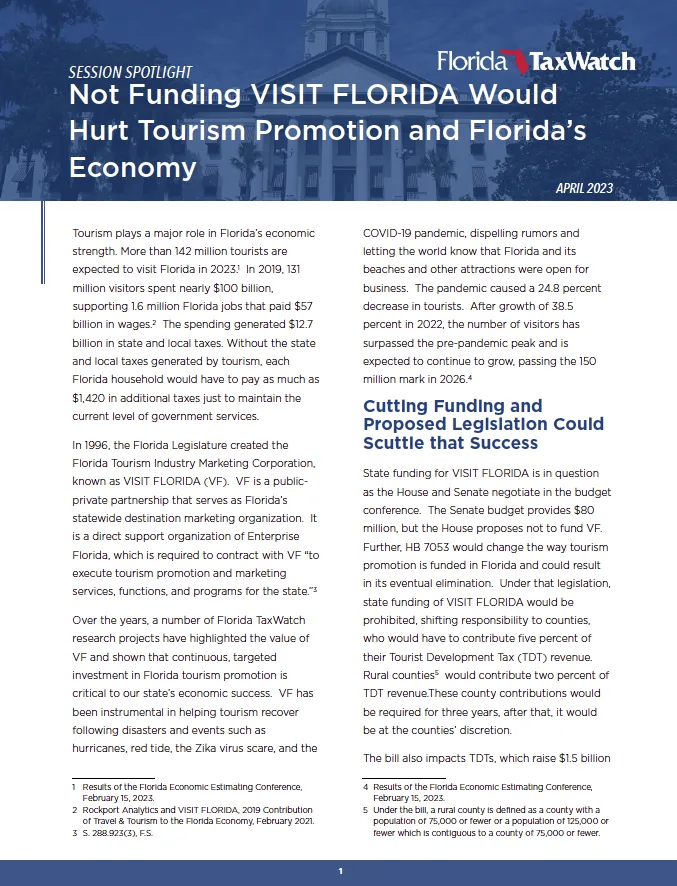
Session Spotlight: Not Funding VISIT FLORIDA Would Hurt Tourism Promotion and Florida’s Economy
Tourism plays a major role in Florida’s economic strength. More than 142 million tourists are expected to visit Florida in 2023. In 2019, 131 million visitors spent nearly $100 billion, supporting 1.6 million Florida jobs that paid $57 billion in wages. The spending generated $12.7 billion in state and local taxes. Without the state and local taxes generated by tourism, each Florida household would have to pay as much as $1,420 in additional taxes just to maintain the current level of government services.

Unlocking Floridians’ economic potential through the Affordable Connectivity Program (ACP)
The COVID-19 pandemic demonstrated the importance of access to reliable and affordable broadband Internet service in our daily lives, which makes available an almost limitless amount of information; provides a platform for education, health care, and commerce; and facilitates family connections, social communication, and idea sharing. What’s more, public and private agencies alike offer critical services and regular updates for citizens through online programs.
